雅思话题 / 考研话题,2025.11.16
077脑腐-brain rot
💌 本资料由@Evelyn每日英语小红书、B站、抖音同名精心整理制作,可添加VX:evelyn_daily交流建议,感谢支持~
视频链接
b站:【用英语吃瓜吧╮(¯▽¯)╭(添如乱】 [https://www.bilibili.com/video/BV18p2FBhEKo/?share_source=copy_web&vd_source=e6c955a1262a936ef61a7618eff4be4b](https://www.bilibili.com/video/BV18p2FBhEKo/?share_source=copy_web&vd_source=e6c955a1262a936ef61a7618eff4be4b)
小红书:5 【一起读外刊背单词—AI和社媒app让人“脑腐”考研英语 外刊表达积累 雅思口语 - Evelyn的语言日记 | 小红书 - 你的生活兴趣社区】 😆 76cbjSGuHrf2J4b 😆 [https://www.xiaohongshu.com/discovery/item/693800bc000000001b030cdc?source=webshare&xhsshare=pc_web&xsec_token=ABZfETVmcuj1Qt5K20YgUKNiERcTkTF61qPcJMVCrCzAw=&xsec_source=pc_share](https://www.xiaohongshu.com/discovery/item/693800bc000000001b030cdc?source=webshare&xhsshare=pc_web&xsec_token=ABZfETVmcuj1Qt5K20YgUKNiERcTkTF61qPcJMVCrCzAw=&xsec_source=pc_share)
🎯 单词串联带背
💡 假装你是小老师!读一遍以下内容吧~遇到不会的表达记得展开看看解释,顺一遍下来真的能学会很多!
今天的内容来自纽约时报的一篇外刊。
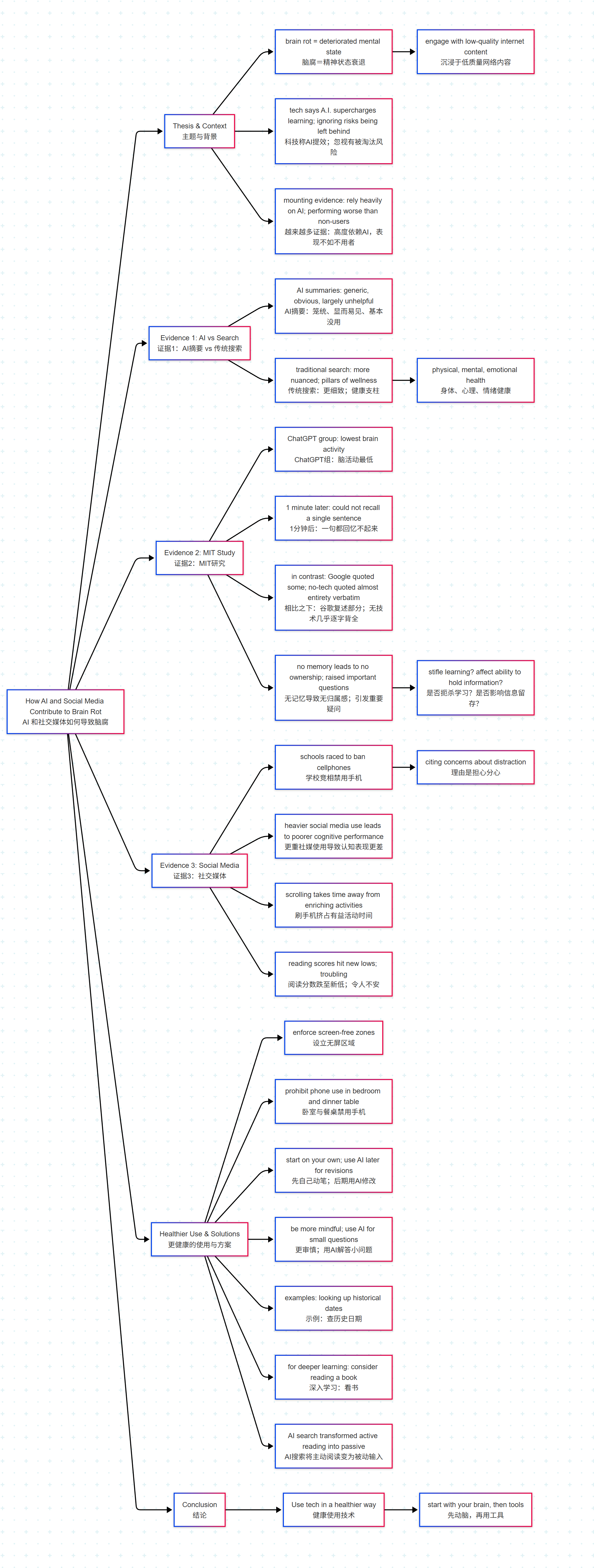
brain rot脑腐。不是卖萌的“老虎”哦,是形容沉浸于低质量网络内容engage with low-quality internet content后精神状态的衰退deteriorated mental state,比如人沉迷短视频hooked on short videos,把脑子看成一团浆糊turn brains into mush。牛津大学出版社把这个词评为2024年度词汇word of the year。 科技公司总说AI会大幅提效supercharge我们的学习,不用就会有被时代淘汰的风险risks being left behind。但《纽约时报》这篇文章告诉我们,事实可能恰恰相反:越来越多的证据mounting evidence表明,高度依赖rely heavily onAI工具和社交媒体应用的人,认知表现cognitive performance反而在下降,迄今so far已经有好几项研究证实了这一点。 那AI和社交媒体到底是怎么让我们的脑子“腐”掉的呢?《纽约时报》给了几个研究案例。
💡 词汇解释
- Brain Rot /breɪn rɒt/:脑腐;沉迷低质量内容导致的精神衰退(2024年度词汇,常见于社媒语境)
- engage with /ɪnˈɡeɪdʒ wɪð/:与…互动;参与(搭配:engage with content/ideas)
- low-quality /ləʊ ˈkwɒl.ə.ti/:低质量的(形容词;反义:high-quality)
- internet /ˈɪn.tə.net/:互联网(名词)
- content /ˈkɒn.tent/:内容(名词;媒体语境常指文本、视频等)
- deteriorated /dɪˈtɪə.ri.ə.reɪ.tɪd/:恶化的、衰退的(过去分词作形容词;动词:deteriorate)
- mental /ˈmen.təl/:心理的、精神的(形容词)
- state /steɪt/:状态(名词;常见搭配:mental state)
- hooked on /hʊkt ɒn/:沉迷于…(非正式用语;近义:addicted to)
- short video /ʃɔːt ˈvɪd.i.əʊ/:短视频(组合名词;平台语境高频)
- turn … into … /tɜːn ˈɪn.tuː/:把…变成…(动词短语;广泛搭配)
- mush /mʌʃ/:糊状物、浆糊(比喻脑子成“浆糊”)
- word of the year /wɜːd əv ðə jɪə/:年度词汇(固定表达;词典机构评选)
- supercharge /ˈsuː.pə.tʃɑːdʒ/:大幅提升;增压(动词;比喻意义常见于效率/学习)
- risk being left behind /rɪsk ˈbiː.ɪŋ left bɪˈhaɪnd/:有被时代淘汰的风险(结构:risk + V-ing;left behind=被落下)
- mounting evidence /ˈmaʊn.tɪŋ ˈev.ɪ.dəns/:越来越多的证据(mounting=增长的;evidence=证据)
- rely heavily on /rɪˈlaɪ ˈhev.ɪ.li ɒn/:高度依赖(搭配:rely on;heavily作程度副词)
- cognitive performance /ˈkɒɡ.nə.tɪv pəˈfɔː.məns/:认知表现(cognitive=认知的;performance=表现)
- so far /səʊ fɑː/:迄今为止、到目前为止(时间副词短语)
第一个证据:AI让你写作时脑子不转了AI turns brains into mush
先说沃顿商学院的Shiri Melumad教授做的实验。她给250个人布置了一项简单写作任务gave a simple writing assignment:写怎么养成更健康的生活习惯how to lead a healthier lifestyle。为了想出点子to come up with tips,一半人可以用传统谷歌搜索找资料,另一半只能依赖rely only on谷歌AI自动生成的信息摘要summaries of information generated automatically。 结果呢?用AI摘要的人写出来的建议很笼统、显而易见、基本没啥用generic, obvious and largely unhelpful——就是那种“多吃健康食物、多喝水、多睡觉”的废话。而用传统搜索的人给的建议更细致到位more nuanced,会关注到健康的各大支柱pillars of wellness,包括身体、心理与情绪健康physical, mental and emotional health。 研究发现,高度依赖聊天机器人的人,表现不如performing worse than不用的人。
💡 词汇解释
- give a simple writing assignment /ɡɪv ə ˈsɪm.pəl ˈraɪ.tɪŋ əˌsaɪn.mənt/:布置简单写作任务(give+assignment常用学术搭配)
- how to lead a healthier lifestyle /haʊ tuː liːd ə ˈhel.θi.ər ˈlaɪf.staɪl/:如何过更健康的生活(lead a lifestyle固定搭配)
- come up with tips /kʌm ʌp wɪð tɪps/:想出建议(come up with=提出/想出)
- rely only on /rɪˈlaɪ ˈəʊn.li ɒn/:只依赖(rely on为核心搭配,only增强限定)
- summaries of information generated automatically /ˈsʌm.ər.iz əv ˌɪn.fəˈmeɪ.ʃən ˈdʒen.ə.reɪ.tɪd ˌɔː.təˈmæt.ɪ.kli/:自动生成的信息摘要(generated过去分词作定语;automatically副词)
- generic, obvious and largely unhelpful /dʒəˈner.ɪk ˈɒb.vi.əs ænd ˈlɑːdʒ.li ʌnˈhelp.fəl/:笼统、显而易见、基本没用(并列形容词描述质量)
- more nuanced /mɔː ˈnjuː.ɑːnst/:更细致(比较级;nuanced表示细微差别)
- pillars of wellness /ˈpɪl.əz əv ˈwel.nəs/:健康的支柱(pillar=支柱;wellness=健康)
- physical / mental / emotional health /ˈfɪz.ɪ.kəl/ /ˈmen.təl/ /ɪˈməʊ.ʃən.əl/:身体/心理/情绪健康(并列三个维度)
- performing worse than /pəˈfɔː.mɪŋ wɜːs ðæn/:表现不如…(比较结构)
第二个证据:用ChatGPT写作,一分钟后啥也记不住When we write with ChatGPT, are we even writing?
另一个受关注研究high-profile study是来自麻省理工的,他们找了54个大学生写作,让学生戴传感器来测量脑电活动wore sensors that measured electrical activity in their brains。一组用ChatGPT,一组用谷歌搜索,一组只能靠自己的大脑来完成作业could rely only on their brains to compose their assignment。 传感器监测发现,用ChatGPT写作的学生脑活动最低showed the lowest brain activity,这也不意外unsurprising,因为AI帮他们干活了。但最惊人的发现the most striking revelation是:写完作文一分钟后,让学生复述quote自己文章的任意片段,绝大多数ChatGPT用户the vast majority of ChatGPT users—83%——一句都回忆不起来could not recall a single sentence! 相比之下in contrast,用谷歌的能复述部分内容quote some parts,不用任何技术的学生能背出很多句,有些甚至几乎能逐字逐句地背出全文quote almost the entirety of their essays verbatim。 研究负责人感叹:“才过了一分钟,就一句也说不出口really cannot say anything?如果不记得自己写了什么,就不会有作品归属感ownership,那么你会在乎你写的东西吗?” 这个结果引发了重要疑问raised impotant questions,AI是否会扼杀/抑制stifle人的学习能力、影响人们记住信息的能力affects people’s ablity to hold on to information。
💡 词汇解释
- high-profile study /ˌhaɪˈprəʊ.faɪl ˈstʌd.i/:受关注研究(high-profile=高曝光度的)
- wore sensors that measured electrical activity in their brains /wɔː ˈsen.səz ðæt ˈmeʒ.əd ɪˈlek.trɪ.kəl ækˈtɪv.ɪ.ti ɪn ðeə breɪnz/:戴传感器测量脑电活动(measured为过去式;activity名词)
- could rely only on their brains to compose their assignment /kʊd rɪˈlaɪ ˈəʊn.li ɒn ðeə breɪnz tuː kəmˈpəʊz ðeər əˈsaɪn.mənt/:只能靠自己的大脑完成作业(compose=写作)
- showed the lowest brain activity /ʃəʊd ðə ˈləʊ.ɪst breɪn ækˈtɪv.ɪ.ti/:脑活动最低(lowest为最高级)
- the most striking revelation /ðə məʊst ˈstraɪ.kɪŋ ˌrev.əˈleɪ.ʃən/:最惊人的发现(striking=显著的;revelation=揭示)
- quote /kwəʊt/:复述/引用(动词;名词同形)
- the vast majority of ChatGPT users /ðə vɑːst məˈdʒɒr.ə.ti əv ˌtʃæt.dʒiː.piːˈtiː ˈjuː.zəz/:绝大多数ChatGPT用户(vast majority固定表达)
- could not recall a single sentence /kʊd nɒt rɪˈkɔːl ə ˈsɪŋ.ɡl ˈsen.təns/:一句都回忆不起来(recall=回忆)
- in contrast /ɪn ˈkɒn.trɑːst/:相比之下(转折连接)
- quote almost the entirety of their essays verbatim /kwəʊt ˈɔːl.məʊst ði ɪnˈtaɪə.rə.ti əv ðeər ˈes.eɪz vɜːˈbeɪ.tɪm/:几乎逐字逐句背出全文(verbatim=逐字地)
- really cannot say anything /ˈrɪə.li ˈkæn.ɒt seɪ ˈeni.θɪŋ/:一句也说不出口(really加强语气)
- ownership /ˈəʊ.nə.ʃɪp/:归属感/所有权(抽象名词;学习归属感语境)
- raised important questions /reɪzd ɪmˈpɔː.tənt ˈkwes.tʃənz/:引发重要疑问(raise=提出/引发)
- stifle /ˈstaɪ.fəl/:扼杀/抑制(动词)
- affects people’s ability to hold on to information /əˈfekts ˈpiː.pəlz əˈbɪl.ɪ.ti tuː həʊld ɒn tuː ˌɪn.fəˈmeɪ.ʃən/:影响人们记住信息的能力(hold on to=保留/记住)
第三个证据:社交媒体和认知能力下降的关系,可能会导致阅读分数很低。Social media may be linked to lower reading scores.
说完AI,再说社交媒体。过去两年,很多州的学校竞相在课堂上禁用手机raced to ban cellphones from classrooms,理由是担心citing concerns学生会被TikTok、Instagram分心distracting themselves with social media apps。 去年一个儿科医生Jasonpediatrician和同事查看了青少年adolescent大脑认知发育项目的数据,这个项目跟踪调查了6500多名9到13岁的青少年。这些小孩每年接受一次问卷调查were surveyed once a year,统计他们使用社交媒体的时长(on how much time they used social media);隔年every other year还要参加若干测试,比如视觉词汇测试visual vocabulary test——把听到的词语与图片正确匹配correctly matching pictures to words they heard。 这个数据显示,每天使用社交媒体从较少到较多from a low amount to a high amount of social media use(1小时到至少3小时)的孩子,他们的阅读、记忆和词汇测试成绩显著更低scored significantly lower,相比之下那些完全不使用社交媒体using no social media的孩子表现更好。 为什么社交媒体会拉低分数social media would harm test scores?Jason博士说,一个稳妥的结论safe conclusion是:孩子每花一小时刷手机scrolling through the apps,就会挤占takes time away from阅读、睡眠等更有益的活动enriching activities的时间。 而正好今年美国儿童阅读分数跌至新低hit new lows,所以这真是个令人不安的troubling消息。
💡 词汇解释
- raced to ban cellphones from classrooms /reɪst tuː bæn ˈsel.fəʊnz frɒm ˈklɑːs.ruːmz/:竞相在课堂上禁用手机(race to=竞相做某事)
- citing concerns /ˈsaɪ.tɪŋ kənˈsɜːnz/:以…为由(cite=引用/说明理由)
- distracting themselves with social media apps /dɪˈstræk.tɪŋ ðemˈselvz wɪð ˈsəʊ.ʃəl ˈmiː.di.ə æps/:用社媒应用让自己分心(distract=分心)
- adolescent /ˌæd.əˈles.ənt/:青少年(名词/形容词)
- were surveyed once a year /wə ˈsɜː.veɪd wʌns ə jɪə/:每年接受一次问卷调查(survey动词/名词)
- every other year /ˈev.ri ˈʌð.ə jɪə/:隔年(时间表达)
- visual vocabulary test /ˈvɪʒ.u.əl vəʊˈkæb.jʊ.lə.ri test/:视觉词汇测试(visual=视觉的;vocabulary=词汇)
- correctly matching pictures to words they heard /kəˈrekt.li ˈmætʃ.ɪŋ ˈpɪk.tʃəz tuː wɜːdz ðeɪ hɜːd/:把听到的词语与图片正确匹配(match…to…结构)
- from a low amount to a high amount of social media use /frɒm ə ləʊ əˈmaʊnt tuː ə haɪ əˈmaʊnt əv ˈsəʊ.ʃəl ˈmiː.di.ə juːs/:每天使用社媒从较少到较多(amount of use=使用量)
- scored significantly lower /skɔːd sɪɡˈnɪf.ɪ.kənt.li ˈləʊ.ə/:成绩显著更低(significantly=显著地)
- using no social media /ˈjuː.zɪŋ nəʊ ˈsəʊ.ʃəl ˈmiː.di.ə/:完全不使用社交媒体(否定表达)
- social media would harm test scores /ˈsəʊ.ʃəl ˈmiː.di.ə wʊd hɑːm test skɔːz/:社交媒体会拉低分数(harm=伤害/损害)
- safe conclusion /seɪf kənˈkluː.ʒən/:稳妥的结论(safe=稳妥;conclusion=结论)
- scrolling through the apps /ˈskrəʊ.lɪŋ θruː ði æps/:刷手机应用(scroll=滚动浏览)
- takes time away from enriching activities /teɪks taɪm əˈweɪ frɒm ɪnˈrɪtʃ.ɪŋ ækˈtɪv.ɪ.tiz/:挤占有益活动的时间(take time away from=占用时间)
- hit new lows /hɪt njuː ləʊz/:跌至新低(hit=达到/造成;lows=低点)
- troubling /ˈtrʌb.lɪŋ/:令人不安的(形容词)
那我们该怎么办?有什么更健康地使用AI和社交媒体的方法?What are some healthier ways to use social media and A.I.?
Jason博士建议家长设立无屏区域enforce screen-free zones,在卧室、餐桌等空间禁止使用手机prohibiting phone use,让孩子在学习、睡眠和吃饭时更专注stay focused。 至于AI工具,MIT的研究里出现了一个有意思的小插曲wrinkle,给了我们一个提示:研究期间,各组对调角色swapped roles,那些最初initially只靠自己写作的学生,后来用ChatGPT时记录到最高的脑活动recorded the highest brain activity;而最初用ChatGPT的学生the students who had initially used ChatGPT,被限制只能靠自己的大脑were restricted to using their brains时,始终达不到前一组的水平were never on a par with the former group。 这说明什么呢?如果你很想用聊天机器人来写作学习are eager to use chatbots for writing and learning,应该先自己开始这个过程,后续阶段再用AI工具做修改consider starting the process on their own before turning to the AI tools later in the process for revisions。就像similar to学数学,先用纸笔学会公式和方程,后面再用计算器解题using calculators to solve problems only after。 AI搜索工具的问题在于,它把原本是主动过程变成了被动过程transformed what was once an active process into a passive one——原本你要浏览链接perusing through links、点击可信来源clicking on a credible source去阅读,现在这些都被自动化automating了。 所以,更健康地(in a healthier way)使用AI的关键也许在于,我们要更加审慎(be more mindful)。不要让聊天机器人包办一个广泛主题的所有研究do all the research on a broad topic,而是把它当作研究过程的一部分(as a part of your research process)来回答小问题(small questions),比如查历史日期looking up historical dates。但如果要深入学习(deeper learning)某个主题,还是看书吧(consider reading a book)。 ok,这就是《纽约时报》这篇文章的核心观点:AI和社交媒体有可能会让我们的脑子“腐”掉,但关键在于我们怎么用。先动脑,再用工具;先主动思考,别被动接受。
💡 词汇解释
- enforce screen-free zones /ɪnˈfɔːs skriːn friː zəʊnz/:设立无屏区域(enforce=实施)
- prohibiting phone use /prəˈhɪb.ɪ.tɪŋ fəʊn juːs/:禁止使用手机(prohibit=禁止)
- stay focused /steɪ ˈfəʊ.kəst/:更专注(stay+形容词结构)
- wrinkle /ˈrɪŋ.kəl/:小插曲/复杂点(在研究语境为细节/变量)
- swapped roles /swɒpt rəʊlz/:对调角色(swap=交换)
- initially /ɪˈnɪʃ.əl.i/:最初地(时间副词)
- recorded the highest brain activity /rɪˈkɔː.dɪd ðə ˈhaɪ.ɪst breɪn ækˈtɪv.ɪ.ti/:记录到最高的脑活动(record=记录)
- were restricted to using their brains /wə rɪˈstrɪk.tɪd tuː ˈjuː.zɪŋ ðeə breɪnz/:被限制只能靠自己的大脑(restrict=限制)
- were never on a par with /wə ˈnev.ə ɒn ə pɑː wɪð/:始终达不到…的水平(on a par with=与…同等)
- are eager to use chatbots for writing and learning /ɑːr ˈiː.ɡə tuː juːz ˈtʃæt.bɒts fə ˈraɪ.tɪŋ ænd ˈlɜː.nɪŋ/:很想用聊天机器人来写作学习(eager=渴望的)
- consider starting the process on their own before turning to the AI tools later for revisions /kənˈsɪd.ər ˈstɑː.tɪŋ ðə ˈprəʊ.ses ɒn ðeər əʊn bɪˈfɔː ˈtɜː.nɪŋ tuː ði ˌeɪ.aɪ tuːlz ˈleɪ.tə fə rɪˈvɪʒ.ənz/:先自己开始过程,后续再用AI工具修改(consider=考虑;turn to=求助)
- similar to /ˈsɪm.ɪ.lə tuː/:就像…(类比表达)
- using calculators to solve problems only after /ˈjuː.zɪŋ ˈkæl.kjʊ.leɪ.təz tuː sɒlv ˈprɒb.ləmz ˈəʊn.li ˈɑːf.tə/:后面再用计算器解题(only after=之后才)
- transformed what was once an active process into a passive one /trænsˈfɔːmd wɒt wəz wʌns ən ˈæk.tɪv ˈprəʊ.ses ˈɪn.tuː ə ˈpæs.ɪv wʌn/:把主动过程变为被动(transform=转变)
- perusing through links /pəˈruː.zɪŋ θruː lɪŋks/:浏览链接(peruse=细读/浏览)
- clicking on a credible source /ˈklɪk.ɪŋ ɒn ə ˈkred.ɪ.bəl sɔːs/:点击可信来源(credible=可信的)
- automating /ˈɔː.tə.meɪ.tɪŋ/:自动化(动名词)
- in a healthier way /ɪn ə ˈhel.θi.ə weɪ/:更健康地(方式状语)
- be more mindful /biː mɔː ˈmaɪnd.fəl/:更审慎(mindful=留心的)
- do all the research on a broad topic /duː ɔːl ðə rɪˈsɜːtʃ ɒn ə brɔːd ˈtɒp.ɪk/:包办一个广泛主题的所有研究(broad=广泛的)
- as a part of your research process /æz ə pɑːt əv jɔː ˈrɪˌsɜːtʃ ˈprəʊ.ses/:研究过程的一部分(as a part of=作为…的一部分)
- small questions /smɔːl ˈkwes.tʃənz/:小问题(small=小的;questions=问题)
- looking up historical dates /ˈlʊk.ɪŋ ʌp hɪˈstɒr.ɪ.kəl deɪts/:查历史日期(look up=查询)
- deeper learning /ˈdiː.pə ˈlɜː.nɪŋ/:深入学习(deeper=更深入的)
- consider reading a book /kənˈsɪd.ər ˈriː.dɪŋ ə bʊk/:考虑看书(consider+V-ing结构)
🎬 场景描述速记单词(含填空练习)
场景1:AI Writing Dependency Meltdown (AI写作依赖症发作)
🎬 场景描述
💡 试着用华裔口气读一遍,你会发现什么是邪修速记单词0:00 / --:--
我现在真的brain rot(脑腐)了!老师给了个simple writing assignment(简单写作任务),我只依赖AI那些automatically generated summaries(自动生成的摘要)。结果写出来的建议非常generic(笼统)、而且obvious(显而易见)、又largely unhelpful(基本没啥用)!我看我室友用传统搜索come up with tips(想点子),她的建议就more nuanced(更细致),涵盖了pillars of wellness(健康支柱),比如physical(身体)方面、mental(心理)方面,还有emotional health(情绪健康)。我的performing worse than(表现不如)她太多!说实话我太hooked on(沉迷)AI工具和刷手机,每天都engage with(沉浸于)那些low-quality internet content(低质量网络内容),mental state(精神状态)都deteriorated(衰退)了,感觉脑子都是mush(浆糊)!虽然科技公司说AI会supercharge(大幅提效)学习,不用就risk being left behind(有被淘汰风险),但现在mounting evidence(越来越多证据)显示,rely heavily on(高度依赖)这些工具的人cognitive performance(认知表现)反而下降!好几项研究都证实了,难怪牛津把brain rot评为2024word of the year(年度词汇)!
📚 本场景词汇表
💡 系统学单词啦~
| 单词 | 词性 | 音标 | 释义 | 例句 |
|---|---|---|---|---|
| brain rot | n. | /breɪn rɒt/ | 脑腐 近义 mental decay 反义 mental sharpness | Too much TikTok gives me brain rot.(刷太多抖音让我脑腐。) |
| simple | adj. | /ˈsɪm.pəl/ | 简单的 近义 easy, straightforward 反义 complex, complicated | It's a simple task.(这是个简单任务。) |
| writing | n. | /ˈraɪ.tɪŋ/ | 写作 近义 composition | I love writing.(我喜欢写作。) |
| assignment | n. | /əˈsaɪn.mənt/ | 任务;作业 近义 task, homework | I finished my assignment.(我完成了作业。) |
| lead | v. | /liːd/ | 过(某种生活);引领 近义 live, conduct 反义 follow | Lead a healthy life.(过健康的生活。) |
| healthier | adj. | /ˈhel.θi.ər/ | 更健康的(healthy的比较级) 近义 more wholesome 反义 less healthy | I want a healthier lifestyle.(我想要更健康的生活方式。) |
| lifestyle | n. | /ˈlaɪf.staɪl/ | 生活方式 近义 way of life | Change your lifestyle.(改变你的生活方式。) |
| rely | v. | /rɪˈlaɪ/ | 依赖;依靠 近义 depend, count on 反义 be independent | Don't rely on others.(别依赖别人。) |
| only | adv. | /ˈəʊn.li/ | 只;仅仅 近义 just, merely 反义 also | I only have one.(我只有一个。) |
| summary | n. | /ˈsʌm.ər.i/ | 摘要;总结 近义 abstract, synopsis 反义 full text | Read the summary first.(先读摘要。) |
| information | n. | /ˌɪn.fəˈmeɪ.ʃən/ | 信息 近义 data, facts | I need more information.(我需要更多信息。) |
| generate | v. | /ˈdʒen.ə.reɪt/ | 生成;产生 近义 create, produce 反义 destroy | AI can generate text.(AI能生成文本。) |
| automatically | adv. | /ˌɔː.təˈmæt.ɪ.kəl.i/ | 自动地 近义 auto, by itself 反义 manually | It works automatically.(它自动运行。) |
| generic | adj. | /dʒəˈner.ɪk/ | 笼统的;通用的 近义 vague, general 反义 specific, detailed | Generic advice doesn't help.(笼统的建议没用。) |
| obvious | adj. | /ˈɒb.vi.əs/ | 显而易见的 近义 clear, evident 反义 obscure, unclear | The answer is obvious.(答案显而易见。) |
| largely | adv. | /ˈlɑːdʒ.li/ | 主要地;基本上 近义 mostly, mainly 反义 slightly | It's largely finished.(基本完成了。) |
| unhelpful | adj. | /ʌnˈhelp.fəl/ | 没用的;无益的 近义 useless 反义 helpful, useful | That was unhelpful.(那没用。) |
| come up with | phrase | /kʌm ʌp wɪð/ | 想出;提出 近义 think of, devise | Come up with an idea.(想出一个主意。) |
| tip | n. | /tɪp/ | 建议;小窍门 近义 advice, suggestion | Give me some tips.(给我些建议。) |
| nuanced | adj. | /ˈnjuː.ɑːnst/ | 细致的;微妙的 近义 subtle, refined 反义 simplistic, crude | A nuanced understanding.(细致的理解。) |
| pillar | n. | /ˈpɪl.ər/ | 支柱;柱子 近义 foundation, cornerstone | Education is a pillar of society.(教育是社会支柱。) |
| wellness | n. | /ˈwel.nəs/ | 健康;幸福 近义 well-being, health 反义 illness | Focus on wellness.(关注健康。) |
| physical | adj. | /ˈfɪz.ɪ.kəl/ | 身体的;物理的 近义 bodily, corporeal 反义 mental | Physical exercise is important.(身体锻炼很重要。) |
| mental | adj. | /ˈmen.təl/ | 心理的;精神的 近义 psychological 反义 physical | Mental health matters.(心理健康很重要。) |
| emotional | adj. | /ɪˈməʊ.ʃən.əl/ | 情绪的;情感的 近义 affective, feelings-related 反义 rational | Emotional support helps.(情感支持有帮助。) |
| health | n. | /helθ/ | 健康 近义 wellness, fitness 反义 illness, disease | Good health is vital.(良好的健康很重要。) |
| perform | v. | /pəˈfɔːm/ | 表现;执行 近义 do, execute 反义 fail | I perform well under pressure.(我在压力下表现良好。) |
| worse | adj./adv. | /wɜːs/ | 更差的;更糟的 近义 inferior 反义 better | It's getting worse.(情况变糟了。) |
| hooked | adj. | /hʊkt/ | 上瘾的;着迷的 近义 addicted, obsessed 反义 indifferent | I'm hooked.(我上瘾了。) |
| engage | v. | /ɪnˈɡeɪdʒ/ | 参与;从事 近义 participate, interact 反义 disengage | Engage with the content.(参与内容。) |
| low-quality | adj. | /ləʊ ˈkwɒl.ə.ti/ | 低质量的 近义 poor-quality, inferior 反义 high-quality | Low-quality products break easily.(低质量产品易坏。) |
| internet | n. | /ˈɪn.tə.net/ | 互联网 近义 web, online 反义 offline | I use the internet daily.(我每天用互联网。) |
| content | n. | /ˈkɒn.tent/ | 内容 近义 material, information | The content is boring.(内容很无聊。) |
| state | n. | /steɪt/ | 状态;国家 近义 condition, status | What's your current state?(你现在什么状态?) |
| deteriorate | v. | /dɪˈtɪə.ri.ə.reɪt/ | 恶化;衰退 近义 worsen, decline 反义 improve | My vision deteriorated.(我的视力恶化了。) |
| turn into | phrase | /tɜːn ˈɪn.tə/ | 变成;转变为 近义 become, transform into | It turned into a disaster.(变成了灾难。) |
| brain | n. | /breɪn/ | 大脑;脑子 近义 mind | Use your brain.(用你的脑子。) |
| mush | n. | /mʌʃ/ | 糊状物;浆糊 近义 pulp, paste 反义 solid | The food turned to mush.(食物变成了糊状。) |
| supercharge | v. | /ˈsuː.pə.tʃɑːdʒ/ | 大幅提效;增压 近义 boost dramatically, turbocharge 反义 slow down, hinder | AI can supercharge productivity.(AI能大幅提高生产力。) |
| risk | v./n. | /rɪsk/ | 冒险;风险 近义 chance, gamble 反义 safety | Don't risk it.(别冒险。) |
| left behind | phrase | /left bɪˈhaɪnd/ | 被落下;被淘汰 近义 abandoned, outdated 反义 ahead, leading | Don't get left behind.(别被落下。) |
| mounting | adj. | /ˈmaʊn.tɪŋ/ | 越来越多的;增长的 近义 growing, increasing 反义 declining | Mounting pressure.(越来越大的压力。) |
| evidence | n. | /ˈev.ɪ.dəns/ | 证据 近义 proof, data | Show me evidence.(给我看证据。) |
| heavily | adv. | /ˈhev.əl.i/ | 严重地;大量地 近义 greatly, extensively 反义 lightly | It rained heavily.(雨下得很大。) |
| cognitive | adj. | /ˈkɒɡ.nə.tɪv/ | 认知的 近义 mental, intellectual | Cognitive abilities decline with age.(认知能力随年龄下降。) |
| performance | n. | /pəˈfɔː.məns/ | 表现;性能 近义 showing, execution | Her performance was excellent.(她的表现很出色。) |
| so far | phrase | /səʊ fɑːr/ | 迄今;到目前为止 近义 until now, up to now 反义 from now on | So far, so good.(到目前为止还不错。) |
| word | n. | /wɜːd/ | 词;单词 近义 term, expression | What's the word?(是什么词?) |
| year | n. | /jɪər/ | 年 近义 twelve months | This year is great.(今年很棒。) |
✏️ 填空练习
💡 ok前面学了那么多,这下来真的了,你可以的!先自己试着填一下然后听音频~0:00 / --:--
Oh my god, I'm totally dealing with 脑腐 right now! The teacher threw us a 简单写作任务, and I went all-in on those 自动生成的摘要. What I churned out was super 笼统, 显而易见, and 基本没啥用. My roommate used old-school search to 想点子, and her tips were way more 细致, covering the 健康支柱 — 身体, 心理, and 情绪健康. I'm clearly 表现不如 her by a mile.
Honestly, I've been way too 沉迷 AI tools and doom-scrolling. Every day I'm just 沉浸于 低质量网络内容. My 精神状态 has 衰退 so badly it’s turned my 脑子 to 浆糊. Tech companies say AI will 大幅提效 learning, and not using it risks 被淘汰. But there's 越来越多证据 that people who 高度依赖 these tools see their 认知表现 drop. No wonder Oxford called “brain rot” the 2024 年度词汇.
🗣️ 完整口语版本
💡 都填出来了的话就跟读一遍吧,加深印象~0:00 / --:--
Oh my god, I'm totally dealing with brain rot right now! The teacher threw us a simple writing assignment, and I went all-in on those automatically generated summaries. What I churned out was super generic, obvious, and largely unhelpful. My roommate used old-school search to come up with tips, and her tips were way more nuanced, covering the pillars of wellness — physical, mental, and emotional health. I'm clearly performing worse than her by a mile.
Honestly, I've been way too hooked on AI tools and doom-scrolling. Every day I'm just engaging with low-quality internet content. My mental state has deteriorated so badly it’s turned my brain to mush. Tech companies say AI will supercharge learning, and not using it risks being left behind. But there's mounting evidence that people who rely heavily on these tools see their cognitive performance drop. No wonder Oxford called “brain rot” the 2024 word of the year.
天哪,我真的脑腐了!老师给我们布置了一个简单写作任务,我一股脑全靠那些自动生成的摘要。我写出来的东西特别笼统、显而易见、而且基本没啥用。我室友用传统搜索自己想点子,她的建议更细致,还覆盖了健康的各大支柱——身体、心理和情绪健康。我明显表现不如她,一下就被比下去了。
说实话,我太沉迷AI工具和刷手机了。每天都在沉浸于这些低质量网络内容。我的精神状态已经衰退到把脑子都变成浆糊了。科技公司说AI会大幅提效学习,不用就会被淘汰。但有越来越多证据显示,高度依赖这些工具的人认知表现在下降。难怪牛津把“brain rot”评为2024年度词汇。
场景2:The Post-ChatGPT Memory Blackout (用完ChatGPT后的记忆黑洞)
🎬 场景描述
💡 试着用华裔口气读一遍,你会发现什么是邪修速记单词0:00 / --:--
我昨天参加了个high-profile study(受关注研究),太离谱了!他们让我们wear sensors(戴传感器)写作文,同时测量electrical activity in brains(脑电活动)。我在可以用ChatGPT那组,旁边有组rely only on their brains(只靠自己大脑)来compose assignment(完成作业)。结果我show the lowest brain activity(脑活动最低),虽然unsurprising(不意外),毕竟AI帮我写的。但写完一分钟后让我们quote(复述)内容,我真的could not recall a single sentence(一句都想不起来)!我们这组The vast majority(绝大多数)都这样!In contrast(相比之下),用谷歌的能quote some parts(复述部分),不用工具的有些甚至能quote verbatim(逐字背出)整篇文章!后来我反思过,刚写完一分钟我就cannot say anything(说不出口)?对自己写的东西也没有ownership(归属感),用AI是不是显得我太不在乎?甚至我觉得AI会不会stifle(扼杀)学习能力呢?
📚 本场景词汇表
💡 系统学单词啦~
| 单词 | 词性 | 音标 | 释义 | 例句 |
|---|---|---|---|---|
| high-profile study | phrase | /ˌhaɪ ˈprəʊ.faɪl ˈstʌd.i/ | 受关注研究 近义 prominent research 反义 obscure study | It's a high-profile study.(这是个高知名度研究。) |
| wore sensors that measured electrical activity in their brains | phrase | - | 戴传感器来测量脑电活动 近义 had brain monitors on | We wore sensors that measured electrical activity in our brains.(我们戴着测量脑电活动的传感器。) |
| could rely only on their brains to compose their assignment | phrase | - | 只能靠自己的大脑来完成作业 近义 had to write manually 反义 could use AI | One group could rely only on their brains to compose their assignment.(一组只能靠大脑完成作业。) |
| showed the lowest brain activity | phrase | /ʃəʊd ðə ˈləʊ.ɪst breɪn ækˈtɪv.ə.ti/ | 脑活动最低 近义 had minimal brain engagement 反义 showed high activity | My results showed the lowest brain activity.(我的结果显示脑活动最低。) |
| unsurprising | adj. | /ˌʌn.səˈpraɪ.zɪŋ/ | 不意外 近义 expected 反义 shocking | The result is unsurprising.(结果不意外。) |
| the most striking revelation | phrase | /ðə məʊst ˈstraɪ.kɪŋ ˌrev.əˈleɪ.ʃən/ | 最惊人的发现 近义 most remarkable finding 反义 unremarkable result | The most striking revelation shocked everyone.(最惊人的发现震惊了所有人。) |
| quote | v. | /kwəʊt/ | 复述;引用 近义 recite 反义 paraphrase | Can you quote your own work?(你能复述你自己的作品吗?) |
| could not recall a single sentence | phrase | /kʊd nɒt rɪˈkɔːl ə ˈsɪŋ.ɡəl ˈsen.təns/ | 一句都回忆不起来 近义 couldn't remember anything 反义 remembered everything | I could not recall a single sentence.(我一句都想不起来。) |
| the vast majority of ChatGPT users | phrase | /ðə vɑːst məˈdʒɒr.ə.ti əv users/ | 绝大多数ChatGPT用户 近义 most ChatGPT users 反义 minority of users | The vast majority of ChatGPT users had the same problem.(绝大多数ChatGPT用户都有同样问题。) |
| in contrast | phrase | /ɪn ˈkɒn.trɑːst/ | 相比之下 近义 by comparison 反义 similarly | In contrast, they did much better.(相比之下,他们做得好得多。) |
| quote some parts | phrase | /kwəʊt sʌm pɑːts/ | 复述部分内容 近义 recall portions 反义 remember nothing | They could quote some parts of the essay.(他们能复述部分内容。) |
| quote almost the entirety of their essays verbatim | phrase | - | 逐字逐句地背出全文 近义 recite word-for-word 反义 couldn't recall | Some could quote almost the entirety of their essays verbatim.(有些人能逐字背出全文。) |
| really cannot say anything | phrase | /ˈrɪə.li ˈkæn.ɒt seɪ ˈen.i.θɪŋ/ | 一句也说不出口 近义 can't speak a word 反义 can recall everything | You really cannot say anything?(你真的一句都说不出来?) |
| ownership | n. | /ˈəʊ.nə.ʃɪp/ | 作品归属感 近义 sense of authorship 反义 detachment | Without memory, there's no ownership.(没有记忆就没有归属感。) |
| raised important questions | phrase | /reɪzd ɪmˈpɔː.tənt ˈkwes.tʃənz/ | 引发了重要疑问 近义 prompted key concerns 反义 answered all questions | This raised important questions.(这引发了重要疑问。) |
| stifle | v. | /ˈstaɪ.fəl/ | 扼杀;抑制 近义 suppress 反义 encourage | Don't stifle creativity.(不要扼杀创造力。) |
| affects people's ability to hold on to information | phrase | - | 影响人们记住信息的能力 近义 impacts memory retention 反义 enhances recall | AI affects people's ability to hold on to information.(AI影响人们记住信息的能力。) |
✏️ 填空练习
💡 ok前面学了那么多,这下来真的了,你可以的!先自己试着填一下然后听音频~0:00 / --:--
I joined this 受关注研究 yesterday — insane! They had us 戴传感器 to write an essay while tracking 脑电活动. I was in the ChatGPT group; another group had to 只靠自己大脑 to 完成作业. My readings 脑活动最低 — totally 不意外 since the AI did the work. But the 最惊人的发现 was this: one minute after we finished, I 一句都回忆不起来! The 绝大多数 of people using ChatGPT were the same. 相比之下, the Google group could 复述部分, and those with no tech could 逐字背出 almost everything. It made me realize I 一句也说不出口, had no real 归属感 for the work, and it 引发了重要疑问 — does using AI 扼杀 learning or 影响人们记住信息的能力?
🗣️ 完整口语版本
💡 都填出来了的话就跟读一遍吧,加深印象~0:00 / --:--
I joined this high-profile study yesterday — insane! They had us wear sensors to write an essay while tracking the electrical activity in our brains. I was in the ChatGPT group; another group had to rely only on their brains to compose their assignment. My readings showed the lowest brain activity — totally unsurprising since the AI did the work. But the most striking revelation was this: one minute after we finished, I could not recall a single sentence! The vast majority of people using ChatGPT were the same. In contrast, the Google group could quote some parts, and those with no tech could quote almost the entirety of their essays verbatim. It made me realize I really cannot say anything, had no real ownership of the work, and it raised important questions — does using AI stifle learning or affect people’s ability to hold on to information?
我昨天参加了个受关注研究——太离谱了!他们让我们戴传感器写作文,同时跟踪脑电活动。我在ChatGPT组;另一组必须只靠自己大脑来完成作业。我的结果脑活动最低——这不意外,毕竟AI在干活。可最惊人的发现是:写完一分钟后,我一句都回忆不起来!绝大多数用ChatGPT的人都这样。相比之下,用谷歌的能复述部分,不用任何技术的甚至能逐字背出几乎全文。这让我意识到我一句也说不出口,对作品没有归属感,这引发了重要疑问——使用AI是否会扼杀学习,或影响人们记住信息的能力?
场景3:Social Media Scrolling Addiction Fallout (刷手机成瘾的后果)
🎬 场景描述
💡 试着用华裔口气读一遍,你会发现什么是邪修速记单词0:00 / --:--
最近好多学校都在课堂race to ban cellphones(竞相禁用手机),因为concern(担心)学生被social media apps(社交媒体)分散注意力。有个pediatrician(儿科医生)做的研究不是说嘛,小孩scrolling through apps(刷手机)会take time away from(挤占)他们阅读、睡眠这些enriching activities(有益活动)的时间,所以刷手机的小孩阅读成绩比using no social media(完全不玩社媒)的小孩低。今年美国儿童阅读分数hit new lows(跌至新低),也让人太troubling(令人不安)了!我决定要enforce screen-free zones(设立无屏区域)了,这个区域内prohibit phone use(禁止使用手机)让小孩stay focused(更专注)。我现在也在控制手机时间,要in a healthier way(更健康地)用工具,be more mindful(更审慎)!可以用AI回答一些small questions(小问题),比如look up historical dates(查历史日期)。但是要deeper learning(深入学习)还是得consider reading a book(看书)!
📚 本场景词汇表
💡 系统学单词啦~
| 单词 | 词性 | 音标 | 释义 | 例句 |
|---|---|---|---|---|
| raced to ban cellphones from classrooms | phrase | - | 竞相在课堂上禁用手机 近义 rushed to prohibit phones 反义 allowed phones | Schools raced to ban cellphones from classrooms.(学校竞相在课堂禁用手机。) |
| citing concerns | phrase | /ˈsaɪ.tɪŋ kənˈsɜːnz/ | 理由是担心 近义 expressing worries 反义 ignoring issues | Citing concerns about distraction.(以担心分心为由。) |
| distracting themselves with social media apps | phrase | - | 被社交媒体应用分心 近义 getting sidetracked by apps 反义 staying focused | Students keep distracting themselves with social media apps.(学生不断被社交媒体分心。) |
| pediatrician | n. | /ˌpiː.di.əˈtrɪʃ.ən/ | 儿科医生 近义 child doctor 反义 adult doctor | The pediatrician gave advice.(儿科医生给了建议。) |
| adolescent | n./adj. | /ˌæd.əˈles.ənt/ | 青少年 近义 teenager 反义 adult | Adolescent brains are still developing.(青少年的大脑仍在发育。) |
| were surveyed once a year | phrase | /wɜː səˈveɪd wʌns ə jɪər/ | 每年接受一次问卷调查 近义 polled annually 反义 never surveyed | They were surveyed once a year.(他们每年接受一次调查。) |
| every other year | phrase | /ˈev.ri ˈʌð.ər jɪər/ | 隔年 近义 biennially 反义 every year | Tests happened every other year.(测试隔年进行。) |
| visual vocabulary test | phrase | /ˈvɪʒ.u.əl vəˈkæb.jə.lər.i test/ | 视觉词汇测试 近义 picture-word matching test | The visual vocabulary test was challenging.(视觉词汇测试很有挑战性。) |
| correctly matching pictures to words they heard | phrase | - | 把听到的词语与图片正确匹配 近义 pairing images with words 反义 mismatching | Kids were correctly matching pictures to words they heard.(孩子们把听到的词与图片正确匹配。) |
| from a low amount to a high amount of social media use | phrase | - | 每天使用社交媒体从较少到较多 近义 from minimal to heavy usage 反义 consistent usage | Going from a low amount to a high amount of social media use harms performance.(社交媒体使用从少到多会损害表现。) |
| scored significantly lower | phrase | /skɔːd sɪɡˈnɪf.ɪ.kənt.li ˈləʊ.ər/ | 成绩显著更低 近义 performed much worse 反义 scored higher | Heavy users scored significantly lower.(重度用户成绩显著更低。) |
| using no social media | phrase | /ˈjuː.zɪŋ nəʊ ˈsəʊ.ʃəl ˈmiː.di.ə/ | 完全不使用社交媒体 近义 avoiding social platforms 反义 heavy social media users | Kids using no social media did best.(完全不用社交媒体的孩子表现最好。) |
| social media would harm test scores | phrase | - | 社交媒体会拉低分数 近义 apps damage performance 反义 improves scores | Research shows social media would harm test scores.(研究显示社交媒体会拉低分数。) |
| safe conclusion | phrase | /seɪf kənˈkluː.ʒən/ | 稳妥的结论 近义 reliable finding 反义 risky assumption | It's a safe conclusion to make.(这是个稳妥的结论。) |
| scrolling through the apps | phrase | /ˈskrəʊ.lɪŋ θruː ði æps/ | 刷手机 近义 browsing apps 反义 closing apps | Endlessly scrolling through the apps wastes time.(无休止地刷手机浪费时间。) |
| takes time away from | phrase | /teɪks taɪm əˈweɪ frəm/ | 挤占 近义 steals time from 反义 gives time to | Phone use takes time away from reading.(用手机挤占阅读时间。) |
| enriching activities | phrase | /ɪnˈrɪtʃ.ɪŋ ækˈtɪv.ə.tiz/ | 有益的活动 近义 beneficial pursuits 反义 wasteful activities | Focus on enriching activities.(专注于有益活动。) |
| hit new lows | phrase | /hɪt njuː ləʊz/ | 跌至新低 近义 reached record lows 反义 hit new highs | Reading scores hit new lows.(阅读分数跌至新低。) |
| troubling | adj. | /ˈtrʌb.lɪŋ/ | 令人不安的 近义 worrying 反义 reassuring | This is troubling news.(这是令人不安的消息。) |
| enforce screen-free zones | phrase | /ɪnˈfɔːs skriːn friː zəʊnz/ | 设立无屏区域 近义 establish device-free areas 反义 allow screens everywhere | Parents should enforce screen-free zones.(家长应该设立无屏区域。) |
| prohibiting phone use | phrase | /prəˈhɪb.ɪ.tɪŋ fəʊn juːz/ | 禁止使用手机 近义 banning device usage 反义 permitting phones | Prohibiting phone use at meals helps.(禁止用餐时用手机有帮助。) |
| stay focused | phrase | /steɪ ˈfəʊ.kəst/ | 更专注 近义 remain concentrated 反义 get distracted | Stay focused on your goals.(保持专注于你的目标。) |
| in a healthier way | phrase | /ɪn ə ˈhel.θi.ər weɪ/ | 更健康地 近义 more mindfully 反义 addictively | Use tech in a healthier way.(更健康地使用科技。) |
| be more mindful | phrase | /bi mɔː ˈmaɪnd.fəl/ | 更加审慎 近义 be more aware 反义 be careless | We need to be more mindful.(我们需要更加审慎。) |
| do all the research on a broad topic | phrase | - | 包办一个广泛主题的所有研究 近义 handle entire investigation 反义 partial assistance | Don't let AI do all the research on a broad topic.(别让AI包办所有研究。) |
| as a part of your research process | phrase | - | 当作研究过程的一部分 近义 as one research tool 反义 as the only tool | Use AI as a part of your research process.(把AI当作研究过程的一部分。) |
| small questions | phrase | /smɔːl ˈkwes.tʃənz/ | 小问题 近义 minor queries 反义 major research | Use it for small questions only.(只用它解决小问题。) |
| looking up historical dates | phrase | /ˈlʊk.ɪŋ ʌp hɪˈstɒr.ɪ.kəl deɪts/ | 查历史日期 近义 checking facts 反义 deep analysis | AI is good for looking up historical dates.(AI适合查历史日期。) |
| deeper learning | phrase | /ˈdiː.pər ˈlɜː.nɪŋ/ | 深入学习 近义 thorough understanding 反义 surface learning | For deeper learning, read books.(要深入学习,读书吧。) |
| consider reading a book | phrase | /kənˈsɪd.ər ˈriː.dɪŋ ə bʊk/ | 看书吧 近义 try reading 反义 avoid books | Consider reading a book instead.(考虑看书吧。) |
✏️ 填空练习
💡 ok前面学了那么多,这下来真的了,你可以的!先自己试着填一下然后听音频~0:00 / --:--
Lately, schools have 竞相禁用手机 in 课堂, 理由是担心 students 被社交媒体分心. A 儿科医生 found that every hour 刷手机 挤占 time for reading, sleep, and other 有益活动. Heavy users 成绩显著更低 than kids 完全不使用社交媒体. This year, children’s reading scores 跌至新低 — pretty 令人不安.
So I’m going to 设立无屏区域 and 禁止使用手机 so kids 更专注. I also want to use AI 更健康地, be 更审慎: let it handle 小问题 like 查历史日期, but for 深入学习 I’ll 看书.
🗣️ 完整口语版本
💡 都填出来了的话就跟读一遍吧,加深印象~0:00 / --:--
Lately, schools have raced to ban cellphones from classrooms, citing concerns that students are distracting themselves with social media apps. A pediatrician found that every hour scrolling through the apps takes time away from reading, sleep, and other enriching activities. Heavy users scored significantly lower than kids using no social media. This year, children’s reading scores hit new lows — pretty troubling.
So I’m going to enforce screen-free zones and prohibit phone use so kids stay focused. I also want to use AI in a healthier way, be more mindfullet it handle small questions like looking up historical dates, but for deeper learning I’ll consider reading a book.
最近很多学校在课堂里竞相禁用手机,理由是担心学生被社交媒体分心。一位儿科医生发现,每小时刷手机都会挤占阅读、睡眠等有益活动的时间。重度使用者成绩显著更低,而完全不使用社交媒体的孩子表现更好。今年孩子们的阅读分数跌至新低——相当令人不安。
所以我要设立无屏区域并禁止使用手机,让孩子更专注。我也要更健康地使用AI,更审慎:让它处理小问题,比如查历史日期;但要深入学习,还是看书。
💬 Small Talk 口语版
💡 和朋友来演一遍吧~也可以自己脑内剧场solo0:00 / --:--
A: Hey girl, what did you get up to this weekend? I was totally hooked on short videos and ended up doom-scrolling for hours – now I feel like I've got serious brain rot!
嘿,姐妹,周末你干嘛了?我完全沉迷于短视频,刷了好几个小时的低质量内容——现在我觉得自己脑子都脑腐了!
B: Oh my gosh, same vibe! I was rushing to finish a simple writing assignment for my prof – he was hounding me about it. So I just relied heavily on ChatGPT and it churned out the whole thing in like five minutes.
天哪,我也是这个感觉!我在赶一个简单写作任务给导师——他一直催我。所以我严重依赖ChatGPT,它快速生成了整篇东西,就五分钟。
A: Haha, that's wild! But wait, did it actually help? I mean, with all that automatically generated stuff, do you even remember what you wrote?
哈哈,太疯狂了!但等等,它真的有帮助吗?我是说,用那些自动生成的东西,你还记得自己写了啥吗?
B: Girl, that's the most striking revelation – at our group meeting, the prof asked me to recap, and I could not recall a single sentence! Turns out, the vast majority of us using AI are in the same boat. It's insane how it messes with your ownership of the work.
姐妹,那就是最惊人的发现——组会上,导师让我复述,我一句都回忆不起来!结果,绝大多数用AI的人都这样。太荒唐了,它怎么就搞乱了你对作品的所有权。
A: Totally! I read this study recently that said we need to enforce screen-free zones at home and prohibit phone use during family time to help kids stay focused. Like, we gotta use AI in a healthier way and be more mindful about it, you know?
完全同意!最近我看了一个研究,说我们需要在家里设立无屏区域,并在家庭时间禁止使用手机,帮孩子更专注。比如,我们得更健康地使用AI,并且更审慎,你懂吧?
B: Yeah, for real. No more letting it take over*our brains – time to reclaim some real thinking! Anyway, wanna grab coffee later?
是的,说真的。别再让它接管我们的大脑了——是时候找回真正的思考了!话说,待会儿要不要去喝杯咖啡?
✍️外刊原文
💡 听音频读外刊~有了前面的解读应该看起来更容易了!
📝 读外刊0:00 / --:--
👩🏻💻 题目
How AI and Social Media Contribute to 'Brain Rot'——AI 和社交媒体是如何导致“脑腐”的
💡 Last spring, Shiri Melumad, a professor at the Wharton School of the University of Pennsylvania, gave a group of 250 people a simple writing assignmentShare advice with a friend on how to lead a healthier lifestyle. To come up with tips, some were allowed to use a traditional Google search, while others could rely only on summaries of information generated automatically with Google's artificial intelligence.
💡 参考译文: 去年春天,宾大沃顿商学院教授 Shiri Melumad 给 250 名参与者布置了一项简单写作任务:给朋友出主意,如何养成更健康的生活习惯。为了想出点子,一部分参与者可以用传统的谷歌搜索找资料,而另一部分人则只能依赖谷歌的 A.I. 自动生成的信息摘要。
💡 The people using A.I.-generated summaries wrote advice that was generic, obvious and largely unhelpful — eat healthy foods, stay hydrated and get lots of sleep! The people who found information with a traditional Google web search shared more nuanced advice about focusing on the various pillars of wellness, including physical, mental and emotional health.
💡 参考译文: 只看 A.I. 摘要的人给出的建议很笼统、显而易见,基本没啥用——比如多吃健康食物、多喝水、多睡觉!而用传统谷歌网页搜索找资料的人,建议更细致到位,关注到了健康的各大支柱(核心方面),包括身体、心理与情绪健康。
💡 The tech industry tells us that chatbots and new A.I. search tools will supercharge the way we learn and thrive, and that anyone who ignores the technology risks being left behind. But Dr. Melumad's experiment, like other academic studies published so far on A.I.'s effects on the brain, found that people who rely heavily on chatbots and A.I. search tools for tasks like writing essays and research are generally performing worse than people who don't use them.
💡 参考译文: 科技公司宣称,聊天机器人和新的 A.I. 搜索工具会大幅提效我们的学习与成长,忽视这类技术的人都面临着被时代淘汰(掉队)的风险。但 Melumad 的实验与迄今关于 A.I. 影响大脑的其他研究一致:在写论文、做研究等任务上高度依赖聊天机器人与 A.I. 搜索的人,整体表现不如不用的人。
💡 “I'm pretty frightened, to be frank,” Dr. Melumad said. “I'm worried about younger folks not knowing how to conduct a traditional Google search.”
💡 参考译文: Melumad 直言:“我真的很担心,说实话。我担心年轻人已经不知道传统的谷歌搜索怎么用了。”
💡 Welcome to the era of “brain rot,” the slang term to describe a deteriorated mental state from engaging with low-quality internet content. When Oxford University Press, the publisher of the Oxford English Dictionary, named brain rot the word of the year in 2024, the definition referred to how social media apps like TikTok and Instagram had people hooked on short videos, turning their brains into mush.
💡 参考译文: 欢迎来到“脑腐”的时代——这个俚语用来形容沉浸于低质量网络内容后精神状态的衰退。当牛津大学出版社在 2024 年将“脑腐”评为年度词汇时,它指的是像 TikTok、Instagram 这样的社交应用让人们沉迷短视频,把脑子看成一团浆糊。
💡 Whether technology makes people dumber is a question as old as technology itself. Socrates faulted the invention of writing for weakening human memory. As recently as 2008, many years before the arrival of A.I.-generated web summaries, The Atlantic published an essay titled, “Is Google Making Us Stupid?” Those concerns turned out to be overblown.
💡 参考译文: 科技会不会让人变笨,这个问题和科技本身一样古老。苏格拉底曾批评书写的发明会削弱人的记忆力。就在 2008 年,也就是 A.I. 网页摘要出现前许多年,《大西洋月刊》还发表《谷歌是否让我们变笨?》。事实证明,那些担忧言过其实(被夸大了)。
💡 But the growing wariness in academia of the impact of A.I. on learning (on top of older concerns about the distracting nature of social media apps) is troubling news for a country whose performance in reading comprehension is already in steep decline.
💡 参考译文: 不过,学术界对AI给学习带来的影响日益警惕(再加上此前本来就觉得社交媒体易让人分心的旧担忧),对于一个阅读理解能力已在急剧下滑的国家来说,是个令人不安的消息。
💡 This year, reading scores among children, including eighth graders and high school seniors, hit new lows. The results, gathered from the National Assessment of Educational Progress, long regarded as the nation's most reliable, gold-standard exam, were the first of their kind to be published since the Covid-19 pandemic disrupted education and drove up screen time among youths.
💡 参考译文: 今年,包括八年级和高中毕业生在内的儿童阅读分数跌至新低。这些结果来自长期被视为全国最可靠、金标准的“全国教育进展评估”(NAEP)。这也是自新冠疫情打乱教学并推高青少年屏幕时长以来首次发布的同类数据。
💡 Researchers worry that evidence is mounting of a potent link between lower cognitive performance and A.I and social media. In addition to recent studies that found a correlation between the use of A.I. tools and cognitive decline, a new study led by pediatricians found that social media use was associated with poorer performance among children taking reading, memory and language tests.
💡 参考译文: 研究人员担心,越来越多的证据表明,认知能力下降与 AI、社交媒体的联系紧密。除了近期研究发现使用 A.I. 工具与认知衰退存在相关性,一项由儿科医生牵头的新研究发现:社交媒体的使用与儿童在阅读、记忆和语言测试中的较差表现之间存在相关性。
💡 Here's a summary on the research so far, and how to use A.I. in a way that boosts — rather than rots — the brain.
💡 参考译文: 下文是目前那些研究的简要综述,以及如何以让大脑增益——而不是腐蚀的方式使用 A.I。
When we write with ChatGPT, are we even writing?用 ChatGPT 写作时,我们真的在“写”吗?
💡 The most high-profile study this year about A.I.'s effects on the brain came out of the Massachusetts Institute of Technology, where researchers sought to understand how tools like OpenAI's ChatGPT could affect how people write. The study, which involved 54 college students, had a small sample size, but the results raised important questions about whether A.I. could stifle people's abilities to learn.
💡 参考译文: 今年关于 A.I. 影响大脑的最受关注的研究来自麻省理工学院(MIT)。研究者试图弄清像 OpenAI 的 ChatGPT 这样的工具会如何影响人们写作。这项研究样本量较小,仅涉及 54 名大学生,但结果引发了重要疑问:A.I. 是否会扼杀(压抑)人的学习能力。
💡 (The New York Times has sued OpenAI and its partner, Microsoft, claiming copyright infringement of news content related to A.I. systems. The two companies have denied those claims.)
💡 参考译文:(《纽约时报》已起诉 OpenAI 及其合作伙伴微软,指控其侵犯新闻内容版权;两家公司已否认相关指控。)
💡 For part of the study, students were asked to write an essay ranging from 500 to 1,000 words, and they were divided into different groupsOne group could write with the help of ChatGPT, a second group could look up information only with a traditional Google search, and a third group could rely only on their brains to compose their assignment.
💡 参考译文: 在研究的一部分中,学生要写一篇 500–1000 字的文章,并被分成不同组别:一组可以借助 ChatGPT写作,第二组只能通过传统的谷歌搜索查资料,第三组只能靠自己的大脑来写作业。
💡 The students wore sensors that measured electrical activity in their brains. The ChatGPT users showed the lowest brain activity, which was unsurprising since they were letting the A.I. chatbot do the work.
💡 参考译文: 学生佩戴测量脑电活动的传感器。使用 ChatGPT 的那组显示出最低的脑活动,一点也不意外,因为他们把工作交给了AI聊天机器人。
💡 But the most striking revelation arose after the students finished the writing exercise. One minute after completing their essays, the students were asked to quote any part of their essay. The vast majority of ChatGPT users (83 percent) could not recall a single sentence.
💡 参考译文: 更惊人的发现出现在写作结束之后:写完作文一分钟后,学生被要求复述自己文章的任意片段。使用 ChatGPT 的人中绝大多数83%一句都回忆不起来。
💡 “It has been one minute, and you really cannot say anything?” said Nataliya Kosmyna, the research scientist at M.I.T. Media Lab who led the study, about the ChatGPT users. “If you don't remember what you wrote, you don't feel ownership. Do you even care?”
💡 参考译文: 研究负责人、麻省理工媒体实验室的 Nataliya Kosmyna 针对使用 ChatGPT 的学生感叹:“才过了一分钟,真的一句也说不出口?如果你不记得自己写了什么,就不会有作品归属感。你会在乎你写的东西吗?”
💡 Though the study focused on essay writing, Dr. Kosmyna said she worried about the implications for people using A.I. chatbots in fields where retention is essential, like a pilot studying to get a license. More research urgently needs to be done, she said, on how A.I. affects people's ability to hold on to information.
💡 参考译文: Kosmyna 说,虽然这项研究聚焦于论文写作,但她担心这对那些在记忆留存至关重要的领域比如飞行员备考拿执照使用聊天机器人的影响。她表示迫切需要开展更多研究,看看 A.I. 如何影响人们记住信息的能力。
Social media may be linked to lower reading scores.社交媒体可能与更低的阅读分数有关。
💡 Over the last two years, schools in states like New York, Indiana, Louisiana and Florida have raced to ban cellphones from classrooms, citing concerns that students were distracting themselves with social media apps like TikTok and Instagram. Lending credence to the bans, a study published last month found a potent link between social media use and poorer cognitive performance.
💡 参考译文: 过去两年,纽约、印第安纳、路易斯安那和佛罗里达等州的学校竞相在课堂上禁用手机,理由是担心学生会被 TikTok、Instagram 等社交媒体应用分心。一项上月发表的研究为禁令提供了佐证(增加了可信度):社交媒体使用与较差的认知表现之间存在强关联。
💡 Last month, the medical journal JAMA published a study conducted by the University of California, San Francisco. Dr. Jason Nagata, a pediatrician who led the study, and his colleagues looked at data from ABCD, for Adolescent Brain Cognitive Development, a research project that followed more than 6,500 youths from age 9 to 13 from 2016 to 2018.
💡 参考译文: 上月,医学期刊 JAMA 刊发了加州大学旧金山分校的一项研究。该研究由儿科医生 Jason Nagata 领衔,他与同事查看了 ABCD(青少年大脑认知发育)项目的数据,该项目在 2016–2018 年间跟踪调查(随访)了 6500 多名9–13 岁的青少年。
💡 All the children were surveyed once a year on how much time they used social media. Every other year, they took several tests. For example, a visual vocabulary test involved correctly matching pictures to words they heard.
💡 参考译文: 所有孩子每年都会接受一次问卷,统计他们使用社交媒体的时长;隔年还要参加若干测试。例如,视觉词汇测试,要求他们把听到的词语与看到的图片正确匹配。
💡 The data showed that children who reported using a low amount of social media (one hour a day) to a high amount at least three hours a dayscored significantly lower on reading, memory and vocabulary tests than children who reported using no social media.
💡 参考译文: 数据显示,每天使用社交媒体较少1 小时到较多至少 3 小时的孩子,在阅读、记忆和词汇测试上的成绩显著更低,相比之下那些完全不使用社交媒体的孩子表现更好。
💡 As for why social media apps like TikTok and Instagram would harm test scores, the only safe conclusion is that every hour a child spends scrolling through the apps takes time away from more enriching activities like reading and sleeping, Dr. Nagata said.
💡 参考译文: 至于 TikTok、Instagram 等社交媒体为何会拉低分数,Nagata 博士说,唯一稳妥的结论是:孩子每花一小时刷手机,就会挤占阅读、睡眠等更有益的活动的时间。
What are some healthier ways to use social media and A.I.?有什么更健康地使用AI和社交媒体的方法?
💡 Despite findings of a correlation between social media use and cognitive decline, it would be difficult to recommend an ideal amount of screen time for youths, because lots of children spend time in front of screens doing things unrelated to social media, like watching TV shows, Dr. Nagata said.
💡 参考译文: 尽管研究发现社交媒体使用与认知退化存在相关性,但Nagata博士表示,很难为青少年推荐一个理想的屏幕使用时长,因为很多孩子的屏幕时间并不都花在社交媒体上,比如他们看电视节目。
💡 Instead, he suggested that parents enforce screen-free zones, prohibiting phone use in areas like the bedroom and dinner table so that children can stay focused on their studies, sleep and mealtimes.
💡 参考译文: 他建议家长设立无屏区域,在卧室、餐桌等空间禁止使用手机,让孩子在学习、睡眠和吃饭时更专注。
💡 Meta did not respond to a request for comment. A TikTok spokeswoman referred to a webpage with instructions to set up Time Away, a tool for parents to create schedules for when their teenagers are allowed to use TikTok.
💡 参考译文: Meta 未回应置评请求。TikTok 的发言人提及了一个网页,上面有关于如何设置“ Time Away”功能的说明,这是一个供家长为青少年设定允许使用 TikTok 时段的工具。
💡 As for A.I. chatbots, there was an interesting wrinkle in the M.I.T. study that presented a possible solution on how people could best use chatbots to learn and write.
💡 参考译文: 至于 A.I. 聊天机器人,麻省理工的研究里出现了一个有意思的小插曲,它提示了一个可能的解决方案:人们该如何更好地利用聊天机器人来学习与写作。
💡 Eventually, the groups in that study swapped rolesThe people who relied only on their brai ns to write got to use ChatGPT, and the people who had relied on ChatGPT could use only their brains. All the students wrote essays on the same topics they had chosen before.
💡 参考译文: 之后,各组对调角色:之前只靠自己写作的人可以使用 ChatGPT,而之前使用 ChatGPT 的人只能靠自己的大脑。所有学生都在之前选择的同一主题下再次写作。
💡 The students who had originally relied only on their brains recorded the highest brain activity once they were allowed to use ChatGPT. The students who had initially used ChatGPT, on the other hand, were never on a par with the former group when they were restricted to using their brains, Dr. Kosmyna said.
💡 参考译文: Kosmyna 说,原本只靠自己写作的学生在获准使用 ChatGPT 时记录到最高的脑活动;而最初使用 ChatGPT 的学生在被限制只能靠自己的大脑时,始终达不到前一组的水平。
💡 That suggests that people who are eager to use chatbots for writing and learning should consider starting the process on their own before turning to the A.I. tools later in the process for revisions, similar to math students using calculators to solve problems only after they have used pencil and paper to learn the formulas and equations. Both Google and OpenAI declined to comment.
💡 参考译文: 这暗示:急着用聊天机器人写作、学习的人,应该先自己动笔,到后续阶段再借助 A.I. 做修改;就像学数学,只有先用纸笔把公式与方程学透,再用计算器解题。谷歌与 OpenAI 均拒绝置评。
💡 Dr. Melumad, the Wharton professor who led the earlier study involving A.I. search tools, said the problem with those tools was that they transformed what was once an active process in your brain — perusing through links and clicking on a credible source to read — into a passive one by automating all of that.
💡 参考译文: 主导早期涉及 A.I. 搜索工具研究的沃顿商学院教授 Melumad 认为,这些工具把原本是大脑里的主动过程——比如逐一浏览链接、点击可信来源去阅读——通过自动化彻底变成了被动输入。
💡 So perhaps the key to using A.I. in a healthier way, she said, is to try to be more mindful in how we use them. Rather than ask a chatbot to do all the research on a broad topic, Dr. Melumad said, use it as a part of your research process to answer small questions, such as looking up historical dates. But for deeper learning of a subject, consider reading a book.
💡 参考译文: 因此,她说,更健康(有益)地使用 A.I. 的关键也许在于,我们要尝试如何在使用它们时更加留心(审慎)。Melumad博士建议,不要让聊天机器人包办一个广泛主题下的所有研究,而是将其作为研究过程的一部分来解答小问题,比如查历史日期。但如果要深入学习某个主题,还是看书吧。
🧠 思维导图
💡 复习一下~